
Automate document collection in real estate by treating every document as a contract obligation with three parts: who owes it, what event starts its clock, and what the buyer gains if it arrives late. Fire the request on the trigger date, chase on a cadence set by the consequence, and timestamp receipt, because receipt starts the next clock. A checklist tracks uploads. Automated document collection tracks obligations, and the four promulgated contracts below tell you exactly which obligations matter.
What the contracts say happens when a document is late
Start with the text, because the text is what a document collection checklist leaves out. Every residential purchase contract in the four largest transaction coordinator markets writes a consequence for late delivery, and the consequence is what should drive document collection.
Colorado, CBS1 (mandatory for contracts on or after January 1, 2026), section 7.4: “Should Buyer receive the Association Documents after Association Documents Deadline, Buyer, at Buyer’s option, has the Right to Terminate under section 24.1 by Buyer’s Notice to Terminate received by Seller on or before ten days after Buyer’s receipt of the Association Documents.”
Try ReBillion Free
Start coordinating transactions like a pro. No credit card required.
California, C.A.R. RPA-CA (12/18 revision), paragraph 14B(3): if any report, disclosure or information for which Seller is responsible is not Delivered within the time specified in paragraph 14A, “then Buyer has 5 (or ___) Days After Delivery of any such items, or the time specified in paragraph 14B(1), whichever is later,” to remove the contingency or cancel.
Texas, Property Code section 5.008(f): “If a contract is entered without the seller providing the notice required by this section, the purchaser may terminate the contract for any reason within seven days after receiving the notice.”
Florida, Statutes section 718.503(2)(d), as amended effective July 1, 2025: a resale condominium contract must state that it “is voidable by buyer by delivering written notice of the buyer’s intention to cancel within 7 days, excluding Saturdays, Sundays, and legal holidays,” after execution and receipt of the association documents. The buyer may also extend closing by up to 7 business days after receipt.
Read those four clauses together and a document collection pattern shows up. Late delivery hands the buyer time, or a termination right, or both. That is the cost of slow document collection, and it is measured in days, not in annoyance.
The consequence ladder: four rungs of document collection
I sort every document a TC has to collect onto one of four rungs, and the rung is what turns a checklist into a document collection plan. The rung sets the chase cadence, the escalation path, and how loudly the system should complain when the document is missing.
Rung 1, the clock resetter. Late delivery restarts a buyer review window. California gives 5 Days After Delivery. Colorado gives ten days after receipt for association documents, title documents, and due diligence documents (CBS1 sections 7.4, 8.2, and 10.6.2.4). Florida gives 7 business days after receipt of the condominium package. Texas gives seven days after receipt of the seller’s disclosure notice. Document collection on this rung has to be fast because every day of delay is a day added to the buyer’s option to walk.
Rung 2, the right creator. Late delivery creates a termination right that did not exist before. In California, once the 7 Days After Acceptance in paragraph 14A pass with a seller item undelivered, the buyer may serve a Notice to Seller to Perform and then cancel. In Texas, if the seller’s disclosure notice is never delivered, the buyer may terminate for any reason up to closing. In Florida, if leases are not disclosed and delivered within 5 days after the Effective Date under paragraph 6(b), the buyer may terminate within 5 days after finally receiving them. Document collection here closes an exposure. Filling the slot is incidental.
Rung 3, the closing blocker with no contract clock. Estoppel certificates, association status letters, loan payoff statements, and insurance binders rarely carry a contract deadline of their own, but closing cannot happen without them. Their clocks are statutory turnaround periods that run from the date of request, which means document collection for this rung is won or lost on the day the request goes out.
Rung 4, the file document. Signed agency disclosures, wire verification records, commission disbursement authorizations, the broker’s own checklist sign-off. Nothing in the purchase contract turns on any of them. The consequence is an audit finding under your state’s brokerage records retention rule, which is real, but it is a different clock owned by a different person. Document collection for rung 4 can run on a weekly sweep instead of a daily chase.
Document delivery clocks in four contracts
The document collection table below reads each obligation from the form or statute named in the sources section. Where a form leaves a blank, the default that applies if the blank is left empty is shown.
| Document | Who owes it | Clock (source) | If late |
|---|---|---|---|
| Seller disclosures, reports, natural hazard booklets (CA) | Seller | 7 Days After Acceptance (RPA 14A) | Buyer gets the later of 17 Days After Acceptance or 5 Days After Delivery; NSP then cancellation (14B(3)) |
| Statutory disclosures delivered after the offer (CA) | Seller | None; the clock is on the buyer | Buyer may cancel within 3 days after in-person delivery or 5 days after mail or electronic delivery (RPA 10A(7); Civ. Code 1102.3) |
| HOA documents (CA) | Seller requests within 3 Days After Acceptance (RPA 10F(2)); association delivers within 10 days of the request (Civ. Code 4530) | 3 days plus 10 days | Buyer’s CI Disclosures contingency stays open under 14B(3) |
| Copies of leases (FL) | Seller | 5 days after Effective Date (ASIS-7 para. 6(b)) | Buyer may terminate within 5 days after receipt |
| Prior title policy and prior survey (FL) | Seller | 5 days after Effective Date (ASIS-7 paras. 9(c), 9(d)) | No stated remedy; slows the title commitment |
| Title commitment (FL) | Seller or buyer per 9(c) | At least 15 days before Closing Date, or 5 if cash under 8(a) | Buyer may extend closing up to 5 days after receipt to examine (Standard A(ii)) |
| Tenant estoppel letters (FL) | Seller | At least 10 days before Closing (Standard D) | Buyer may terminate within 5 days after receipt, no later than 5 days before Closing |
| Condominium resale package (FL) | Seller, at seller’s expense | Buyer entitled on contract (s. 718.503(2)) | Buyer may void within 7 business days after receipt, or extend closing up to 7 business days |
| Seller’s disclosure notice (TX) | Seller | On or before the effective date (Prop. Code 5.008(f)) | Buyer may terminate for any reason within 7 days after receiving it |
| Association Documents (CO) | Seller, at seller’s expense | Association Documents Deadline (CBS1 7.2) | Buyer may terminate up to ten days after receipt, or by Closing if never received (7.4) |
| Title Documents and abstracts (CO) | Seller | Record Title Deadline (CBS1 8.1.5, 8.1.6) | Buyer has the earlier of Closing or ten days after receipt to object (8.2) |
| Due Diligence Documents: leases, leased-item and solar agreements (CO) | Seller | Due Diligence Documents Delivery Deadline (CBS1 10.6.1) | Ten days after receipt to object; Resolution Deadline moves to fifteen days after receipt (10.6.2.4) |
| Seller’s Property Disclosure (CO) | Seller | Seller’s Property Disclosure Deadline (CBS1 10.1) | New adverse fact disclosed later: buyer may terminate within five days after receipt (10.2) |
Two things in that document collection table surprised people I have shown it to. First, California’s late-delivery reset is small. Five Days After Delivery is usually swallowed by the 17-day investigation window, so the real lever on the seller side is the Notice to Seller to Perform, not the extension. Second, Colorado’s reset is large and stacks. A late association package, a late title document, and a late lease each carry their own ten-day tail, and the Due Diligence Documents Resolution Deadline slides to fifteen days after receipt. In Colorado, slow document collection can push a buyer’s last exit past the original closing date.
The HOA package runs on a third-party clock
Rung 3 deserves its own document collection table because the association is not a party to the contract and does not care about the contract’s deadlines. Its obligation runs from the date it receives a proper request.
| State | What the association must deliver | Turnaround from request (source) | Fee rule |
|---|---|---|---|
| California | The Civ. Code 4525 document set (governing documents, budget, reserves, assessments, litigation) | 10 days of mailing or delivery of the written request (Civ. Code 4530(a)) | Reasonable fee based on actual cost, charged to the seller; written fee estimate on the 4528 form before processing |
| Florida (condominium) | Estoppel certificate | 10 business days (s. 718.116(8)) | Statute reads $250, plus $100 for delivery within 3 business days and up to $150 more if delinquent; DBPR adjusts the figures for CPI every 5 years and publishes the current amounts |
| Florida (HOA) | Estoppel certificate | 10 business days (s. 720.30851) | Same schedule as 718.116(8); no fee may be charged if the association misses the 10 business days |
| Texas | Restrictions, bylaws and rules, and a resale certificate | 10th business day after receipt of the request and verified authority (Prop. Code 207.003(a)); updates within 7 business days (207.003(f)) | Set by the association, subject to 207.003 |
| Colorado | Statement of unpaid assessments | 14 calendar days after receipt of a request delivered personally or by certified mail to the registered agent (C.R.S. 38-33.3-316(8)) | If no statement is furnished, the association loses its lien for assessments due before the request as against the requesting party |
The practical rule for document collection on this rung: the request date is the only variable you control. A Texas resale certificate requested on day 1 of a 30-day contract arrives by day 14 at the latest. Requested on day 12, it arrives by day 26, four days before closing, with no room for the update the title company will ask for. The same request, sent by automated document collection on the effective date, costs nothing extra and buys two weeks.
Florida adds a twist: early document collection is in the seller’s interest too. The 7-business-day rescission window in 718.503(2)(d) runs from the buyer’s receipt of the package. A seller who sends the package on day 10 has kept the buyer’s walk-away right alive until roughly day 19. A seller who sends it with the executed contract closes that window by day 9.
Worked example: one contract, four states
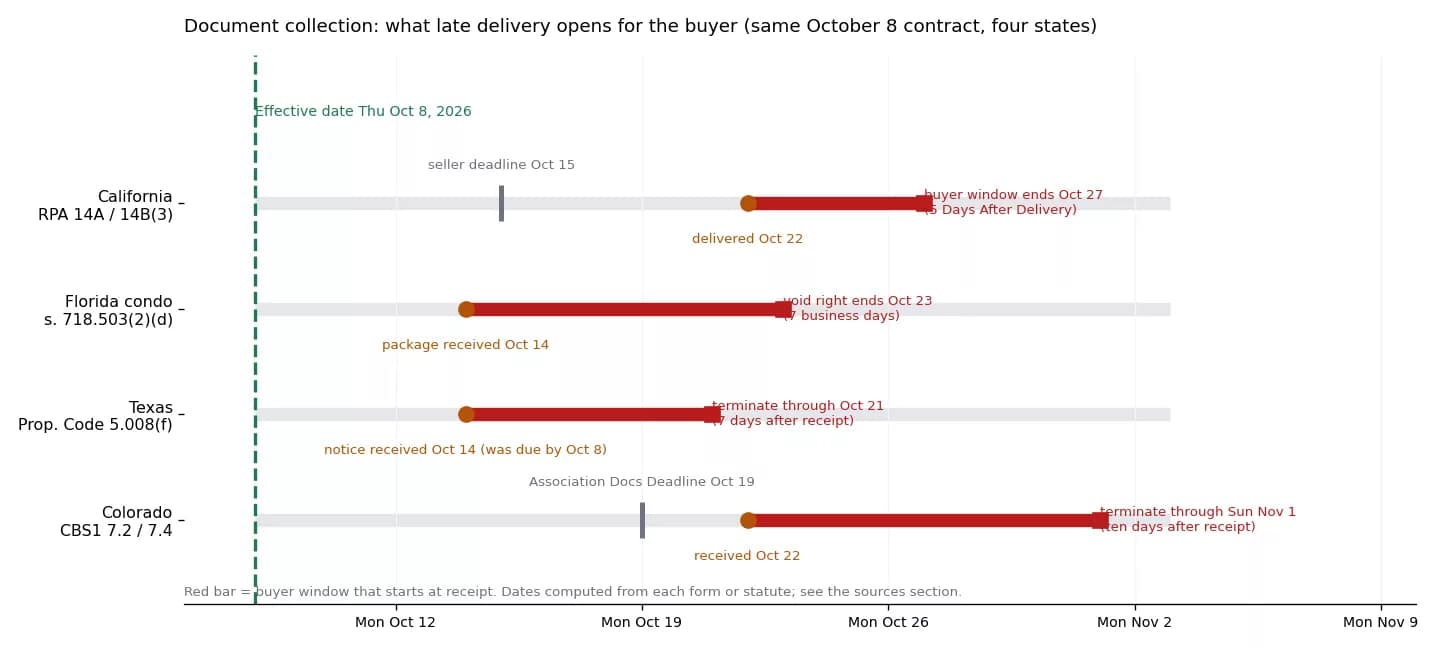
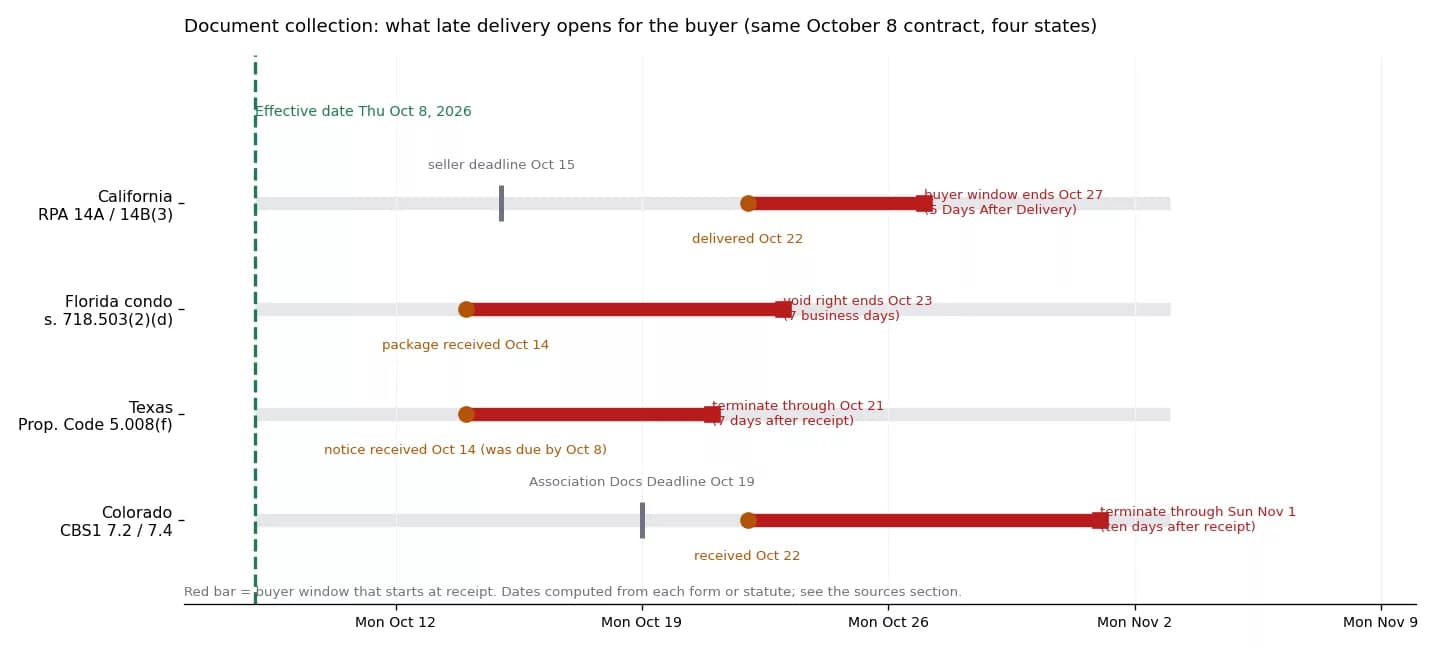
Take a contract with an effective date of Thursday, October 8, 2026, and assume document collection fails the same way in each state: the same document arrives late. All dates below were computed from the counting rules in each form, not estimated.
- California. Seller’s 7 Days After Acceptance ends Thursday, October 15. Buyer’s 17-day window ends Sunday, October 25, which the RPA’s definition of Days moves to Monday, October 26. The seller delivers the disclosure package on Thursday, October 22, a week late. Buyer now has the later of October 26 or 5 Days After Delivery, which is Tuesday, October 27. One week of seller delay bought the buyer one extra day, but it also opened the Notice to Seller to Perform path on October 16.
- Florida condominium. The package arrives Wednesday, October 14. Counting seven days that are not Saturdays, Sundays, or legal holidays, the buyer may void the contract through Friday, October 23, and may extend closing by the same span.
- Texas. The seller’s disclosure notice was not delivered before the effective date. It arrives Wednesday, October 14. The buyer may terminate for any reason through Wednesday, October 21. Had it never arrived, the buyer could terminate right up to closing.
- Colorado. The Association Documents Deadline was set for Monday, October 19. The package arrives Thursday, October 22. The buyer’s termination right now runs to ten days after receipt: Sunday, November 1, at 11:59 p.m. Mountain Time, because CBS1 section 3.3.3 does not extend a weekend deadline unless the box is checked, and the default is not extended.
What automated document collection has to do
Given the ladder, an automated document collection system needs five behaviours. If a tool you are evaluating cannot do all five, it is a checklist with reminders, and I have watched checklists with reminders miss a Colorado association deadline while showing every box green.
1. Fire the request on the trigger event. The trigger is the effective date for most seller items, the request date for association items, and the contract’s own deadline for the rest. A document collection system that waits for a TC to open the file has already lost the Texas resale certificate days.
2. Set the chase cadence by rung. Rung 1 and rung 2 documents get a document collection follow-up every business day from the day before the deadline. Rung 3 gets a status check at the midpoint of the statutory turnaround and a demand on the last day. Rung 4 gets a weekly sweep.
3. Timestamp receipt, because receipt starts the next clock. The California 5 Days After Delivery, the Colorado ten days after receipt, the Florida 7 business days, and the Texas 7 days all start at receipt. If the document collection system records “uploaded” instead of “delivered to buyer at 3:12 p.m. on October 22,” it cannot compute the buyer’s deadline, and the deadline post on automating real estate deadlines explains why that single timestamp matters more than the calendar.
4. Check completeness before calling it delivered. The Florida statute lists eight enumerated items in the condominium package. The Colorado form lists six categories of Association Documents and a separate Due Diligence Documents set. A package that is missing the reserve study or the last annual meeting minutes has not started the buyer’s clock. Document collection that counts pages is not document collection.
5. Escalate by channel and log it. Email first, then text, then a call, each document collection attempt logged against the file with who was contacted, when, and what they said. Rung 1 and rung 2 items escalate on a two-day miss. Rung 3 items escalate the day after the statutory turnaround passes, with the statute cited in the message.
This is the part of document collection ReBillion was built for. ReBillion is an AI control plane that orchestrates your stack. It reads every contract, tracks every deadline, and coordinates your TMS, CRM, signature, and comms, so the request goes out on the trigger date, the chase follows the rung, receipt is timestamped, and the file shows who was asked and when. If you want to see the document collection flow on one of your own files, book a demo, and the pricing page shows what it costs per transaction.
What I would not automate
Two document collection judgment calls stay with a human. First, whether a package is “unsatisfactory” in the buyer’s sole subjective discretion is the buyer’s call, and the TC’s job is to make sure the buyer knows the day the window closes. Second, whether a late seller item justifies a Notice to Seller to Perform is a strategy decision for the agent. Automated document collection should surface both decisions with the dates attached and then get out of the way.
For the rest of the transaction file beyond document collection, the AI transaction coordinator guide covers what an AI TC handles end to end, the condo transaction coordinator guide goes deeper on the association package, and the transaction email management post covers the inbox side of the chase. State-specific fees and timelines are on the California, Florida, Texas, and Colorado transaction coordinator pages, and the brokerage document management guide covers storage once the documents are in.
Sources and versions
Every document collection clock above was read from the primary text in September 2026. Contract forms change; verify the revision on the executed contract before relying on a default.
California: RPA-CA Revised 12/18, paragraphs 10A(7), 10F, 14A, 14B(3), and the definitions of Days and Days After. C.A.R. has since issued the 12/25 revision, which is members-only and renumbers these paragraphs; the 7-day seller delivery and 5 Days After Delivery mechanics are quoted from the 12/18 text. Civil Code 1102.3 and Civil Code 4530.
Florida: ASIS-7 Rev. 12/24, paragraphs 6(b), 9(c), 9(d), Standards A, D, and F. Section 718.503, 718.116, 720.401, and 720.30851, 2025 Florida Statutes. The resale rescission window in 718.503(2)(d) was 3 business days in the 2024 statutes and is 7 business days in the 2025 statutes; the Senate summary of HB 913 gives the July 1, 2025 effective date. Most explainers online still say 3 days.
Texas: Property Code 5.008 and Property Code 207.003, read from the Public.Law mirror because the Legislature’s site did not render for our tools; the mirror reproduces the official text with its source link.
Colorado: CBS1 Contract to Buy and Sell Real Estate (Residential), for use on or after January 1, 2026, sections 3.3, 7.2 through 7.4, 8.1, 8.2, 10.1, 10.2, and 10.6. C.R.S. 38-33.3-316(8).
Market context: the NAR REALTORS Confidence Index for August 2026 reports that 14% of contracts had delayed settlements in the prior three months and 7% were terminated, with contracts typically closing in 30 days. The report does not break out document delays as a cause, so no share is claimed here.
Not asserted: the DBPR-adjusted estoppel fee amounts (the DBPR site blocked retrieval, so only the statutory base figures appear above), the TREC contract’s own disclosure-notice paragraph (the TREC PDF was unreachable this time; the statute is the source of the right in any case), and any “typical” number of documents per file, which no primary source measures.
Frequently asked questions
What does it mean to automate document collection in real estate?
It means a system fires each document request on its trigger date, follows up on a cadence set by the consequence of being late, escalates across email, text, and phone, timestamps receipt because receipt starts the buyer’s review clock, and checks the package for completeness before marking it delivered.
Which documents should a transaction coordinator collect first?
Start with the documents whose late delivery resets a buyer clock or creates a termination right: seller disclosures in California and Texas, the condominium package in Florida, and Association Documents in Colorado. Then start document collection for third-party items such as estoppels and resale certificates on day one, because their statutory turnaround runs from the request.
How long does an HOA have to deliver documents?
California associations have 10 days from the written request under Civil Code 4530. Florida condominium and homeowners associations have 10 business days to issue an estoppel certificate. Texas associations have 10 business days to deliver subdivision information and a resale certificate. Colorado associations have 14 calendar days to furnish a statement of unpaid assessments.
What happens if a seller delivers disclosures late in California?
Under RPA paragraph 14B(3), late document collection on the seller side means the buyer gets the later of the original 17-day window or 5 Days After Delivery to remove the contingency or cancel. Once the seller’s 7 Days After Acceptance pass, the buyer may also serve a Notice to Seller to Perform and then cancel.
How many days does a Florida condo buyer have to cancel after receiving the documents?
For contracts executed on or after July 1, 2025, section 718.503(2)(d) gives a resale buyer 7 days, excluding Saturdays, Sundays, and legal holidays, after receiving the required package. The 2024 statute said 3 days, and many summaries have not caught up.
Can document collection be fully automated?
The requesting, chasing, escalating, timestamping, and completeness checking can be automated, and that is most of the work. Whether a package is satisfactory and whether to serve a notice to perform remain decisions for the buyer and the agent, so the system should surface those choices with the dates attached rather than make them.

Written by Vikas Malpani
Vikas Malpani is the CEO and Co-Founder of ReBillion and a CAR-Certified Transaction Coordinator. A serial real estate technology entrepreneur with 15+ years across technology and real estate operations, he was named to MIT Technology Review's TR35 list of young innovators. At ReBillion he leads the AI systems that deliver compliant, accurate transaction coordination for brokerages and agents across the 10 states ReBillion serves. Connect with Vikas on LinkedIn: https://www.linkedin.com/in/vikasmalpani/
View Profile