
Earnest money deposit rules in the United States are set state by state, and every state runs at least two separate clocks: a contract clock that tells the buyer when to deliver the earnest money deposit, and a license-law clock that tells the brokerage when the funds must be in a trust account. In the thirteen states verified here, the license-law clock ranges from the next banking day (Washington, Idaho) to the fifth business banking day (Virginia), and three of them set no number at all. There is no federal rule and no 50-state standard.
Three clocks, not one
Most transaction coordinators track one earnest money deposit date: the day the buyer has to get the check or wire to escrow. That date comes from the purchase contract, it is easy to find, and it is the one the listing agent will call about. It is also only a third of the picture.
Earnest money deposit rules operate in three layers, and each has its own deadline, its own trigger event, and its own consequence for missing it.
Get Your Free Demo
See how ReBillion can streamline your real estate business.
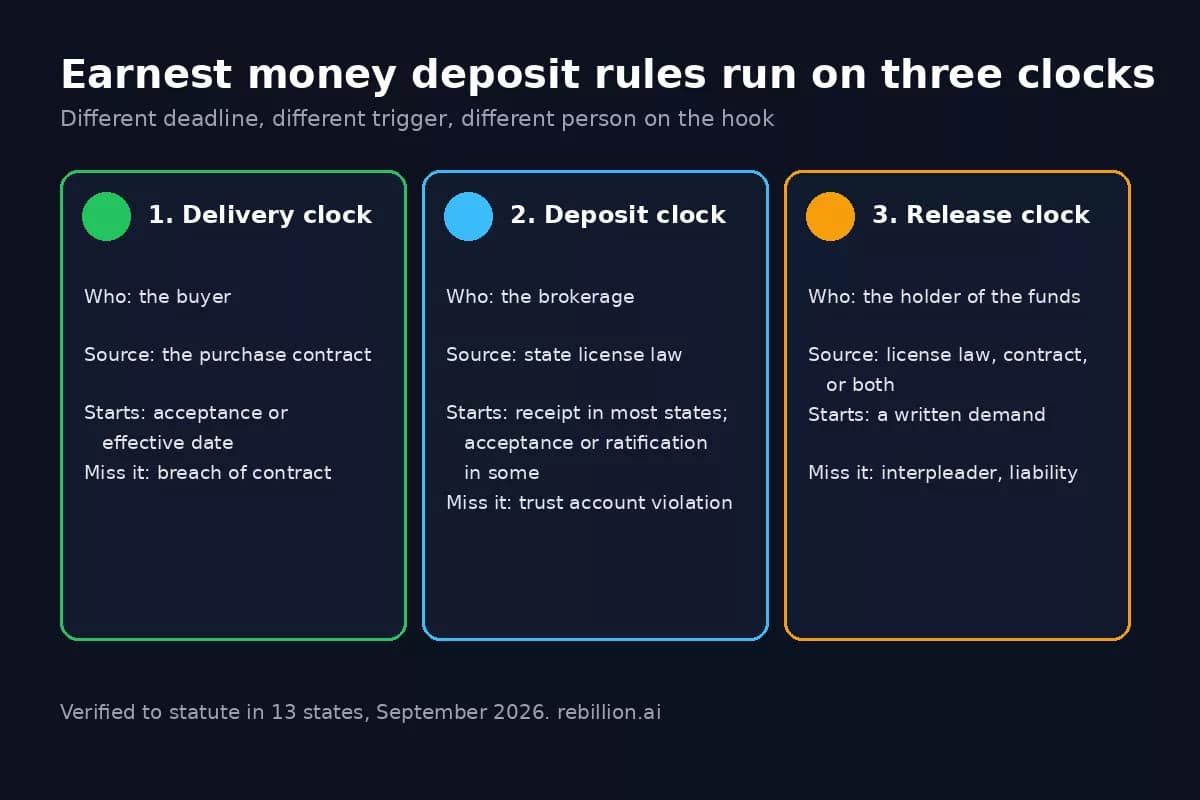
The delivery clock is contractual. The buyer promises, in the purchase agreement, to hand the earnest money deposit to a named holder within some number of days after acceptance. Miss it and the buyer is in breach of contract. The regulator does not care.
The deposit clock is statutory. Once a brokerage or its agent has the funds in hand, the state real estate license law says how quickly those funds must land in a trust account or a neutral escrow. Miss it and the broker, not the buyer, has a license-law problem, and the seller may never even hear about it. The auditor will.
The release clock is the one nobody reads until a deal dies. When buyer and seller both claim the earnest money deposit, the license law or the contract, sometimes both, prescribe a waiting period and a menu of exits (mutual release, interpleader, mediation, or a regulator order).
The three clocks are usually confused with each other, and the confusion is not harmless. The most common error in published earnest money deposit rules, including the version of this page that existed before this rewrite, is quoting the contract delivery period as if it were the law. In Georgia, for example, the widely repeated five banking days is a term in the GAR purchase and sale form. The Georgia Real Estate Commission rule says the broker must deposit “promptly” and gives no number. Those are different obligations, owed by different people.
The deposit clock: earnest money deposit rules by state
The table below covers only the license-law earnest money deposit clock, and only states where the statute or rule text was read directly this month. It is thirteen states, not fifty. Everything in it is quoted or paraphrased from the regulator, and the citation is included so you can check it.
| State | Earnest money deposit deadline (license law) | Day unit | Clock starts on | Citation |
|---|---|---|---|---|
| California | Not later than 3 business days | Business days | Receipt by broker or salesperson (or acceptance, if the check was held uncashed by written instruction) | 10 CCR 2832(a), (d); B&P 10145 |
| Texas | Close of business on the 2nd working day | Working days | Date the broker receives the trust money | 22 TAC 535.146(b)(3) |
| Florida | End of the 3rd business day | Business days (Sat, Sun, holidays excluded) | Receipt, and receipt by a sales associate counts as receipt by the broker | Fla. Stat. 475.25(1)(k); Rule 61J2-14.008(3), 14.009 |
| Arizona | No number. “Immediately” or “on receipt” | None stated | Receipt | A.R.S. 32-2151(A) |
| Colorado | No later than 3 business days | Business days | Receipt of funds or mutual execution of the contract, whichever is later | 4 CCR 725-1, Rule 5.7.B |
| Nevada | Broker: “promptly,” no number. Licensee must pay over to the broker or escrow within 1 business day | Business days (licensee rule) | Receipt of a fully executed contract (licensee rule) | NRS 645.310(4); NAC 645.657 |
| Oregon | Principal broker: “immediately.” Broker to principal broker within 3 banking days; a held check is deposited within 3 banking days of acceptance | Banking days | Receipt (agent handoff); acceptance (held check) | ORS 696.241(3); OAR 863-015-0257 |
| Washington | The next banking day | Banking days (Sat, Sun, holidays excluded) | Receipt, unless the purchase agreement provides for deferred deposit | RCW 18.85.285(7); WAC 308-124E-105(6) |
| Idaho | On or before the banking day immediately following receipt | Banking days | Receipt day (physical possession or assumed responsibility to deposit) | Idaho Code 54-2045(1), 54-2044(2) |
| Utah | Within 3 business days | Business days | Receipt of the client money, unless the contract states a specific holding period or deposit on acceptance | Utah Admin. Code R162-2f-401c(1)(h) |
| Georgia | “Promptly,” no number (a new trust account must be opened within 1 business day) | None stated | Receipt | Rule 520-1-.08(1)(d); O.C.G.A. 43-40-20(a) |
| North Carolina | 3 banking days after receipt; but an earnest money check received with a pending offer goes in within 3 days after acceptance | Banking days (general); “days” (pending-offer exception) | Receipt (general); acceptance (check held with offer) | 21 NCAC 58A .0116(a), (b)(3) |
| Virginia | End of the 5th business banking day | Business banking days | Ratification (firm holds funds); receipt (funds going to an outside escrow agent) | Va. Code 54.1-2108.2; 18VAC135-20-180 |
Two things jump out of that table. First, the spread is wide: a Washington broker who receives an earnest money deposit on Friday has until Monday; a Virginia broker on the same facts has until the following Friday. Second, three of thirteen states (Arizona, Georgia, Nevada) give the broker a word like “promptly” or “immediately” rather than a number, and Oregon does the same at the principal broker level, attaching its numbers to the agent handoff and the held check instead. A TC system that hard-codes “three business days” as the national earnest money deposit default is wrong in most of these states in one direction or the other.
The delivery clock: what the standard contracts say about the earnest money deposit
The delivery clock lives in the form, so it changes when the form changes, and the number is blank in more places than you would expect. Here is what the dominant contract in each state says about when the buyer must deliver, read from the current published form where it was available.
| State | Form | Buyer must deliver the earnest money deposit | Day unit in the form |
|---|---|---|---|
| California | C.A.R. RPA, paragraph 3A | Within 3 business days after Acceptance (12/18 revision; current revision is members-only and was not read) | Business days |
| Texas | TREC 20-18, paragraph 5A | Within 3 days after the Effective Date; weekend or holiday rolls to the next day | Calendar days |
| Florida | FR/Bar 7x, paragraph 2(a) | Within 3 days after Effective Date if left blank | Calendar days (Standard F) |
| Colorado | CBS1 (mandatory from Jan 1, 2026), section 4.3 | With the contract, unless an Alternative Earnest Money Deadline is filled in | Calendar, per section 3.3 |
| Nevada | Las Vegas REALTORS RPA rev. 10/24, section 1(A) | Within 1 business day of acceptance unless a different number is filled in | Business days |
| Oregon | OREF 001 (01/2026), section 31.1 | Within 3 business days after the Effective Date if left blank | Business days |
| Washington | NWMLS Form 21 rev. 7/23, general term b | 2 days after mutual acceptance if left blank | Periods of 5 days or less exclude weekends and holidays |
| Idaho | RE-21, section 3(A) (2017 edition read) | Within 3 business days of acceptance if left blank | Business days |
| Utah | State-approved REPC (eff. Dec 4, 2024) | No later than 4 calendar days after Acceptance; the brokerage then has 4 calendar days to deposit | Calendar days |
| Georgia | GAR F201 (2023 edition read), paragraph 7 | Blank; parties fill in days from the Binding Agreement Date. Holder deposits within 5 banking days | Banking days |
| North Carolina | NC Form 2-T rev. 7/2025, paragraph 1(d) | Within 5 days of the Effective Date | Calendar days (paragraph 22) |
| Virginia | Virginia REALTORS Form 600 rev. 06/24, paragraph 3 | Blank; parties fill in days after full execution | Calendar days |
| Arizona | AAR Residential Resale Purchase Contract | Not verified this run; the association PDF could not be read | Not verified |
Notice Florida. The contract counts calendar days and the license rule counts business days. An earnest money deposit that is on time under one can be measured against the other and look late, or the reverse. Notice Utah, where the state-approved contract gives the brokerage four calendar days to deposit while the administrative rule says three business days unless the contract states a specific period. Whether the contract language qualifies as “a specific length of time” under the rule is a question for the Utah Division, not for a blog post, and the safe operating assumption is the shorter of the two.
Business day, banking day, working day, and the Virginia hybrid
Earnest money deposit rules use four different day units across these thirteen states, and they are not interchangeable.
Business days, in the states that define them (Florida, Washington, Idaho’s contract), exclude Saturdays, Sundays, and legal holidays. Banking days exclude days the banks are closed, which is nearly the same set but not identical; a state holiday on which banks stay open is a banking day and may not be a business day. Texas uses “working day” and does not define it in the rule. Virginia invented “business banking day,” which is presumably the intersection of the two. Calendar days count everything.
The practical consequence is that “three days” is not a duration. It is a duration plus a calendar plus a definition. Three calendar days from a Friday acceptance is Monday. Three business days from the same Friday is Wednesday. Three banking days from a Friday before a Monday bank holiday is Thursday. A deadline engine that stores “3” and a start date without storing the unit will be wrong every time a weekend or a holiday falls inside the window.
Receipt, acceptance, ratification: the trigger matters more than the number
The number gets all the attention. The trigger event is where the real variance is, and it is also where audits find violations.
Most states start the earnest money deposit clock on receipt: the moment the brokerage physically has the funds. Idaho defines receipt to include the moment anyone at the brokerage “assumes the responsibility to deliver or deposit” the funds, which is earlier than physical possession in an office that mostly takes wires. Florida goes further and says receipt by a sales associate is receipt by the broker for purposes of the three-day rule, so the associate who sits on a check over a long weekend has already burned two of the broker’s three days.
Colorado starts the clock on the later of receipt or mutual execution, which is the sane way to handle a check that arrives with an offer that has not been accepted yet. Virginia starts it on ratification when the firm is holding the funds, and on receipt when the funds are going to an outside escrow agent. Nevada’s one numeric rule binds the licensee rather than the broker and starts on receipt of a fully executed contract, not receipt of the money. North Carolina keeps two clocks in one rule: three banking days from receipt in general, but a check that came in with a pending offer must be deposited within three days after acceptance.
California, Oregon, Washington, and Utah all allow an earnest money deposit check to be held uncashed until acceptance, but only when the contract or a written instruction says so. Absent that writing, the receipt clock runs from the day the check arrived, accepted offer or not. That is the single most common way a perfectly well run brokerage ends up with a technical trust-account violation: the agent held a check during a three-day counteroffer exchange out of habit, and nothing in the file authorized it.
A Friday acceptance, worked across nine states
Take a contract accepted Friday, October 2, 2026, at 6 p.m. The buyer wires or hands over the earnest money deposit on Saturday, October 3, and the receiving agent forwards it to the brokerage the same day. No holidays fall in the following week. Applying the earnest money deposit rules above:
| State | Buyer delivery deadline (contract) | Brokerage earnest money deposit deadline (license law) | Note |
|---|---|---|---|
| California | Wed Oct 7 (3 business days after acceptance) | Wed Oct 7 (3 business days following Saturday receipt) | The two clocks coincide only because delivery happened the day after acceptance |
| Texas | Mon Oct 5 (3 calendar days after Effective Date) | Tue Oct 6 (close of business, 2nd working day after receipt) | Sales agent must hand funds to the broker immediately |
| Florida | Mon Oct 5 (3 calendar days) | Wed Oct 7 (end of 3rd business day following receipt) | Associate must deliver to broker by Mon Oct 5 |
| Washington | Tue Oct 6 (2 days after mutual acceptance, weekends excluded) | Mon Oct 5 (next banking day after receipt) | The license clock is shorter than the contract clock; it just starts later |
| Idaho | Wed Oct 7 (3 business days) | Mon Oct 5 (banking day following receipt) | Same shape as Washington |
| Utah | Tue Oct 6 (4 calendar days) | Wed Oct 7 under either reading (3 business days or 4 calendar days from receipt) | The rule and the contract happen to agree on these dates |
| Colorado | With the contract (Fri Oct 2) unless an alternative deadline is set | Wed Oct 7 (3 business days after the later of receipt or MEC) | MEC is the later event here |
| North Carolina | Wed Oct 7 (5 calendar days) | Wed Oct 7 (3 banking days following Saturday receipt) | If the check had come in with the offer, the clock would instead be 3 days after Friday acceptance |
| Virginia | Blank in the form; parties set it | Fri Oct 9 (5th business banking day following Friday ratification) | Longest license clock in the set |
Nine states, one fact pattern, earnest money deposit deadlines spanning Monday through Friday. Any workflow that applies one number to all of them is not tracking earnest money deposit rules. It is tracking a guess.
The handoff clock inside the brokerage
There is a fourth clock hiding inside the second one, and it is the one that catches unlicensed transaction coordinators and new agents. Before the brokerage can bank an earnest money deposit, the person who received it has to get it to the person who can deposit it.
The states are blunt about this. California: a salesperson “shall immediately deliver the funds to the broker.” Texas: trust money received by a sales agent “must be immediately delivered” to the sponsoring broker. Idaho: consideration received by a sales associate “shall be immediately delivered to the broker or the broker’s office.” North Carolina: money received by a provisional broker “shall be delivered upon receipt” to the affiliated broker. Florida gives the associate until the end of the next business day. Oregon gives the broker three banking days to get earnest money to the principal broker. Georgia says “as soon after receipt as is practicably possible.”
In every one of these states, the handoff clock and the deposit clock run concurrently, not consecutively. The Florida associate does not get a business day and then the broker gets three more; the broker’s three started when the associate took the check. That is the fact most brokerage trust-account policies get wrong in writing, and it is the reason a TC who receives an earnest money deposit should treat the receipt timestamp, not the handoff timestamp, as day zero.
The release clock: what happens when the deal dies
The release clock only matters for the files that fail, which is why nobody builds it into the checklist, and why it produces the ugliest disputes. The rules vary more here than anywhere else.
Texas gives the broker 30 days after a written demand to pay the earnest money deposit to whoever is entitled to it, and the TREC contract lets the escrow agent disburse to the demanding party if the other side does not object within 15 days. Florida requires the broker to notify the Commission within 15 business days of conflicting demands and start one of four settlement procedures within 30 business days. Virginia lets the broker send a release notice and disburse if no written protest arrives within 15 calendar days, and grants the complying broker immunity. Washington has a statute (RCW 64.04.220) with a 15-day, then 20-day, then 10-day sequence and a mandatory interpleader if an objection lands. Oregon has an optional 20-calendar-day return-to-depositor procedure. Idaho lets the broker rely on the contract and disburse at the broker’s own discretion, with civil liability but no license violation. Utah gives 15 days to refer the parties to mediation if the contract calls for it. North Carolina requires a written release or a court order, or deposit with the clerk of court after 90 days.
The common thread is that the release clock starts on a written demand for the earnest money deposit, and the demand is almost always an email to an agent, not a letter to the broker. If that email is not surfaced to whoever tracks the file, every downstream deadline is already running before anyone knows it exists. That is a document-capture problem before it is a legal one.
Building earnest money deposit rules into the file
The reason earnest money deposit rules are handled badly is not that TCs do not know them. It is that the information needed to apply them is scattered across three systems. The delivery deadline is in the contract PDF. The receipt timestamp is in an email or a wire confirmation. The state, and therefore the unit and the trigger, is in the transaction management system. Nobody joins those three fields on purpose, so the deposit deadline is computed in someone’s head, or not at all.
This is the class of problem ReBillion was built for. ReBillion is an AI control plane that orchestrates your stack: it reads the executed contract, pulls the acceptance date and the earnest money deposit terms, watches the inbox for the receipt event, and computes the delivery and deposit deadlines against the correct state rule and day unit, then coordinates your TMS, CRM, signature, and comms so the alert reaches whoever can act on it while there is still time to act. When a written demand for the earnest money deposit shows up in a thread, it is flagged as a release-clock event rather than filed as correspondence. The AI transaction coordinator model behind it is described in detail elsewhere on this blog, and the deadline tracking comparison covers how it differs from a shared calendar.
If you want to see it run against your own state forms, book a demo. Pricing is one predictable monthly fee set by your volume; details are on the pricing page.
What this guide does not cover
It does not cover the other 37 states. It covers thirteen because those are the thirteen where the primary text was read this month, and publishing a number I did not bind to a statute is how the wrong figures got into circulation in the first place. It does not cover how large a typical earnest money deposit is; NAR’s home buyer surveys do not measure that, and the percentages that circulate online trace back to commentary, not data. It does not cover commercial contracts, which set their own terms, or the general mechanics of escrow, which are in the escrow and earnest money deposits guide. And it does not cover how long the trust-account records themselves must be kept, which is a separate clock again and is covered in the brokerage records retention guide. Trust-account handling more broadly sits inside the brokerage compliance checklist.
Statutes and forms change. Every citation above was read in September 2026. Confirm against the current text before relying on it, and treat this as a map of where to look rather than legal advice.
Sources
California: 10 CCR 2832 and B&P 10145. Texas: 22 TAC 535.146 and TREC 20-18. Florida: Fla. Stat. 475.25, 61J2-14.008, 61J2-10.032. Arizona: A.R.S. 32-2151. Colorado: 4 CCR 725-1 Chapter 5. Nevada: NAC 645.657. Oregon: OAR 863-015-0257. Washington: RCW 18.85.285, WAC 308-124E-105, RCW 64.04.220. Idaho: Idaho Code 54-2045. Utah: R162-2f-401c. Georgia: Rule 520-1-.08. North Carolina: 21 NCAC 58A .0116 and Form 2-T. Virginia: Va. Code 54.1-2108.2.
Frequently asked questions
How many days does a broker have to bank an earnest money deposit?
The earnest money deposit clock depends on the state, and the range in the thirteen states verified here is the next banking day (Washington, Idaho) to the fifth business banking day (Virginia). California, Colorado, Florida, and Utah use three business days. Texas uses the second working day. Arizona, Georgia, and Nevada give the broker no number and say promptly or immediately. There is no federal rule.
Is the earnest money deposit deadline in the contract the same as the one in state law?
No. The contract deadline tells the buyer when to deliver the earnest money deposit and is enforced between buyer and seller. The license-law deadline tells the brokerage when received funds must be in a trust account and is enforced by the state real estate regulator against the broker. They use different triggers and often different day units.
What counts as a business day versus a banking day for earnest money deposit rules?
Business days exclude Saturdays, Sundays, and legal holidays where the state defines the term. Banking days exclude days banks are closed. Texas uses working days without defining them. Virginia uses business banking days. Several standard contracts count calendar days instead. The unit is part of the rule, so it has to be stored with the deadline.
When does the deposit clock start if the check arrives before the offer is accepted?
In most states the earnest money deposit clock starts on receipt regardless of acceptance, unless the contract or a written instruction authorizes holding the check uncashed until acceptance. California, Oregon, Washington, and Utah all recognize that exception when it is in writing. Colorado starts the clock on the later of receipt or mutual execution. North Carolina requires a check received with a pending offer to be deposited within three days after acceptance.
Who is liable if an agent holds an earnest money deposit check too long?
The broker. In Florida the rule states that receipt by a sales associate is receipt by the broker, so the broker three-day clock starts when the associate takes the check. Most other states require the agent to deliver funds to the broker immediately or upon receipt, and the deposit clock runs from the original receipt, not from the handoff.
What is the release clock for a disputed earnest money deposit?
The period the holder of the earnest money deposit must wait after a written demand before disbursing or interpleading. Examples from the primary text: Texas allows 30 days after demand for broker-held funds; Florida requires notice to the Commission within 15 business days; Virginia permits release if no protest arrives within 15 calendar days; Washington runs a 15-day notice and 20-day objection sequence under RCW 64.04.220.

Written by Vikas Malpani
Vikas Malpani is the CEO and Co-Founder of ReBillion and a CAR-Certified Transaction Coordinator. A serial real estate technology entrepreneur with 15+ years across technology and real estate operations, he was named to MIT Technology Review's TR35 list of young innovators. At ReBillion he leads the AI systems that deliver compliant, accurate transaction coordination for brokerages and agents across the 10 states ReBillion serves. Connect with Vikas on LinkedIn: https://www.linkedin.com/in/vikasmalpani/
View Profile